What Businesses Need to Know About Making Tax Digital for Income Tax
What Businesses Need to Know About Making Tax Digital for Income Tax (MTD-IT)
After years of preparation and delays, the government's Making Tax Digital for Income Tax (MTD for IT) finally came into effect on 6 April 2026. As expected (and intended), it is transforming the way sole traders and landlords report to HM Revenue and Customs (HMRC). What's more, as Accountancy Age notes, UK accountants are "at the heart of this shift", helping clients to stay compliant and get ahead of the curve.
What is Making Tax Digital for Income Tax?
As the name suggests, Making Tax Digital is an HMRC initiative to modernise the tax system. It replaces traditional paper records with mandatory digital record-keeping and regular electronic updates. The first phase, Making Tax Digital for VAT, launched in April 2019 for around 1.2 million VAT-registered businesses above the VAT threshold. It was extended to all VAT-registered businesses from April 2022, which brought in around 1.1 million more.
The government says the potential benefits of MTD for IT include:
- Time saving. Submitting digitally through software is generally quicker than paper filing, though getting set up can take time. HMRC's 2025 research into MTD for VAT estimated that businesses using fully functional MTD software save an average of 33 hours a year (a range of 26 to 40 hours). HMRC values this time at between £603 million and £915 million to the wider economy in 2022/23.
- More tax confidence. Sending quarterly updates gives businesses a clearer view of the health of their business and helps them estimate their annual tax bill. This in turn helps them set aside the funds they need, and spot and correct accounting errors before they become serious problems.
- Improved business operations. Using bank-fed software and updating records more often helps make reporting more accurate and timely than "back of an envelope" or spreadsheet methods. This is a win-win for both HMRC and taxpayers. With real-time data, the government should have a better idea of what funds to expect in the near future, while sole traders and landlords should be able to plan their finances more effectively.
Who Will Be Affected by MTD for IT?
The first phase of MTD for IT applies to sole traders and landlords with qualifying income from self-employment and/or property income exceeding £50,000 on their 2024/25 tax return. Qualifying income is their total gross income from self-employment and property, before expenses.
The first quarterly update covered 6 April to 5 July 2026 and was due by 7 August 2026. The next update, covering the period up to 5 October 2026, is due by 7 November 2026.
What are the Quarterly MTD for IT Deadlines?
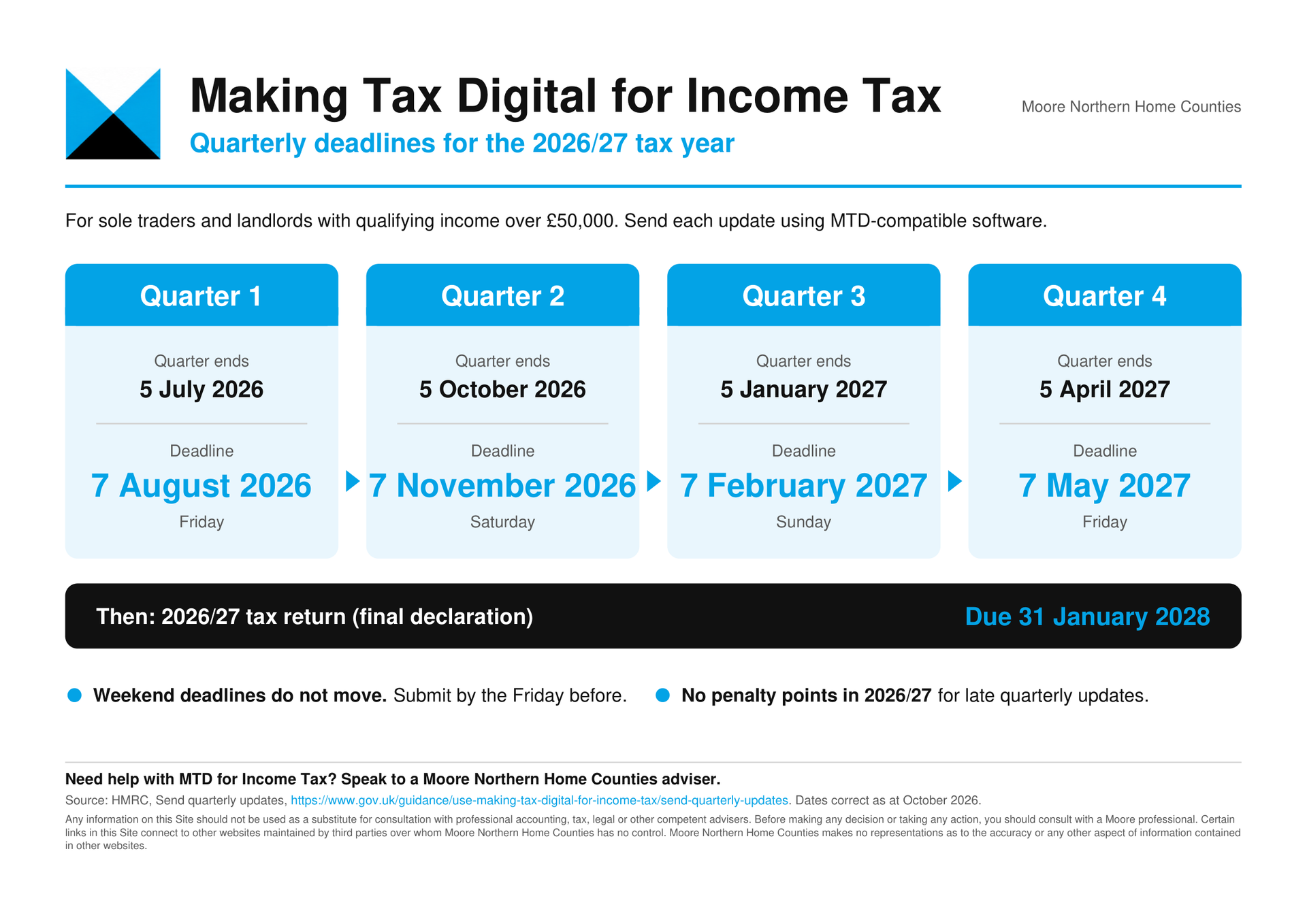
Quarterly digital updates are required on top of the annual tax return, which must now also be filed using MTD-compatible software. A quarterly update is not the same as a tax return because it needs far less information. Everyone affected still needs to complete their annual filing.
The threshold drops to more than £30,000 of qualifying income, from April 2027, based on the 2025/26 tax return. It then drops to more than £20,000 of qualifying income, from April 2028. This will significantly widen the number of sole traders and landlords reporting to HMRC every quarter.
HMRC estimates that around 2.9 million people will eventually be affected. You can check if and when the rules apply to you on
GOV.UK or get in touch with our tax team who will be glad to assist you.
Client Concerns around MTD for IT
Making Tax Digital is one of the biggest changes to self assessment in a generation, and it will no doubt take time for many to adjust. Understandably, many sole traders and landlords have concerns about the new processes. Here are some of the concerns we are hearing:
- Too much admin. Instead of filing one tax return a year, those affected now have to make at least five submissions: four quarterly updates plus the annual return. That might sound like a lot of extra (paperless) paperwork. However, the admin should get lighter as the automated processes kick in and the benefits outlined above take effect.
- Extra costs. Many sole traders are also worried about the extra cost, particularly of software. As with all digital change, the less confident you are with computers, the harder the change will be. HMRC does not provide its own software, but third-party providers offer a mix of free and paid MTD-compatible products. Moore Northern Home Counties can offer clients discounted licenses for both Xero and QuickBooks. Some free options are aimed at sole traders with simpler affairs. HMRC's software finder can help you find a suitable product.
- More penalties for non-compliance. Another common fear is that more deadlines will mean more fines. To ease this concern, the government has brought in a
points-based penalty system instead of immediate fines for missed submissions. Each missed quarterly deadline earns one point, and a £200 penalty only applies once four points are reached. HMRC has also confirmed it will not issue penalty points for late quarterly updates in the 2026/27 tax year. Points-based penalties start from 6 April 2027. Late payment penalties and interest still apply as normal.
Are you ready for Making Tax Digital for Income Tax?
In the run-up to the first deadline, a lot of people weren't ready. A Lloyds Bank survey of 1,000 sole traders, carried out in late June and early July 2026, found that 55% were not prepared for the first submission deadline on 7 August. Lloyds estimated this could represent around 475,000 sole traders and landlords.
Take-up has since gathered pace.
According to HMRC, more than 436,000 sole traders and landlords submitted their first quarterly update, and over 570,000 had signed up to MTD for Income Tax, by 12 August 2026.
If you have not yet made your first submission, it makes sense to get guidance on MTD for IT and submit as soon as possible. Late quarterly updates in 2026/27 will not get penalty points, but all of them must still be submitted before your annual return.
If it's any consolation, it's not just sole traders and landlords who have found the change challenging. A 2025 Accountex survey
reported by Accountancy Age found that 81.7% of accountants saw MTD as their biggest challenge that year, and 79% saw it as their greatest opportunity. Around one in three (34%) said they were not yet prepared.
That is not the case here at Moore Northern Home Counties. If you are a sole trader, private landlord or small business owner, we can check whether MTD for IT applies to you. If it does, we can recommend suitable software, set up the bookkeeping processes you need and make sure your quarterly submissions are compliant and filed on time.
Are you affected by MTD for Income Tax?
- Sole trader?
- Property landlord?
- Total qualifying income above £30,000?
If you answered "yes", contact us by clicking below.
ARTICLE TITLE: What Businesses Need to Know About Making Tax Digital for Income Tax (MTD-IT)
AUTHOR: GEORGIA LAMMING - TAX TEAM - MOORE NHC
DATE: 30 OCTOBER 2026
Please note: TAX rates, allowances, thresholds and dates, are subject to change. Blog correct as at 30.10.2026
Any information on this Site should not be used as a substitute for consultation with professional accounting, tax, legal or other competent advisers. Before making any decision or taking any action, you should consult with a Moore professional. Certain links in this Site connect to other websites maintained by third parties over whom Moore Northern Home Counties has no control. Moore Northern Home Counties makes no representations as to the accuracy or any other aspect of information contained in other websites.
Recent Posts