
Statutory Audit Thresholds
To Audit Or Not to Audit?
That is the question facing over 130,000 UK SMEs.
One of the Rishi Sunak government’s last acts in office was to increase company size thresholds, which, among other things, determine whether a company requires a statutory audit (medium-size and large companies do while small and micro businesses don’t). The consequences of that action are only now being felt, and for an estimated 132,000 firms those consequences are big.
The main goal of the initiative was to reduce SMEs’ admin burden and costs, so that they (in the words of the government) “can focus on their growth and delivering for their customers.” SMEs, the government said, are the “lifeblood of local communities" and a key driver of the UK economy. They were also hit particularly hard by the economic fallout of the COVID-19 lockdowns.
New Limits
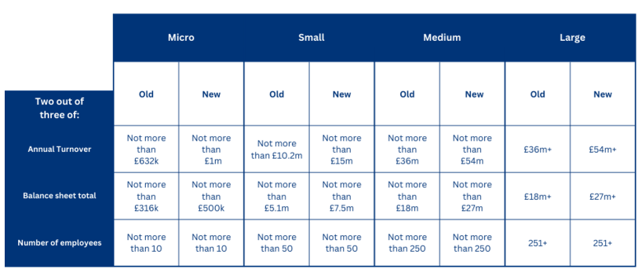
Prior to the threshold changes, to qualify as a small company (and therefore not require a statutory audit), companies needed to tick at least two of the following three boxes.
They needed to have:
- An annual turnover of not more than £10.2 million.
- A balance sheet total of not more than £5.1 million.
- A workforce of not more than 50 employees.
After the rule changes, the annual turnover and balance sheet thresholds were increased by roughly 50% to £15 million and £7.5 million, respectively. The workforce threshold remained the same, at 50 employees. As shown in the graph below, these alterations formed part of wholesale changes to turnover and balance sheet thresholds for all company categories.
The timing of the impact of these regulatory changes varies, depending on each company’s year end. For those with a December year end, the first affected period began on 1st January, 2026 and will end on 31st December, 2026. By contrast, for companies with a March year end, the first period commenced on 1 April, 2026 and ends on 31 March, 2027.
A Prickly Dilemma
As a result of these changes, an estimated 132,000 firms have been downsized from medium to small, meaning they are no longer subject to a statutory audit. As a result, they will be able to redirect the funds and resources usually allocated to an audit, to benefit other parts of their business.
But they may want to pause a moment before doing that.
Instead of focusing exclusively on the cost benefits, the companies should consider the potential impact of removing the audit process on their operations. After all, audits, whether statutory or voluntary, serve vital functions. Most importantly, they provide transparency for investors, lenders and other key stakeholders. Removing the audit process risks undermining stakeholder confidence.
There are moments in a firm’s life cycle when stakeholder confidence is indispensable. If your firm is considering a future sale or exit, or is looking to increase borrowing or improve financing conditions, an audit provides an added layer of trust and confidence that may make the difference between a successful outcome and an unsuccessful one.
There are other compelling reasons for retaining the audit process, such as good governance, fraud deterrence and improved detection of accounting errors. In addition, if your company is going through a period of particularly fast growth, conducting a voluntary audit will help to ensure that the internal control environment is properly structured to allow it to deal with that growth.
In short, audits can provide oft-overlooked benefits for firms that may be sorely missed further down the road. This is why the Sunak government’s decision to raise company size thresholds, while broadly beneficial, presents a prickly dilemma for many of the businesses affected: to audit or not to audit?
Now, that is the question.